
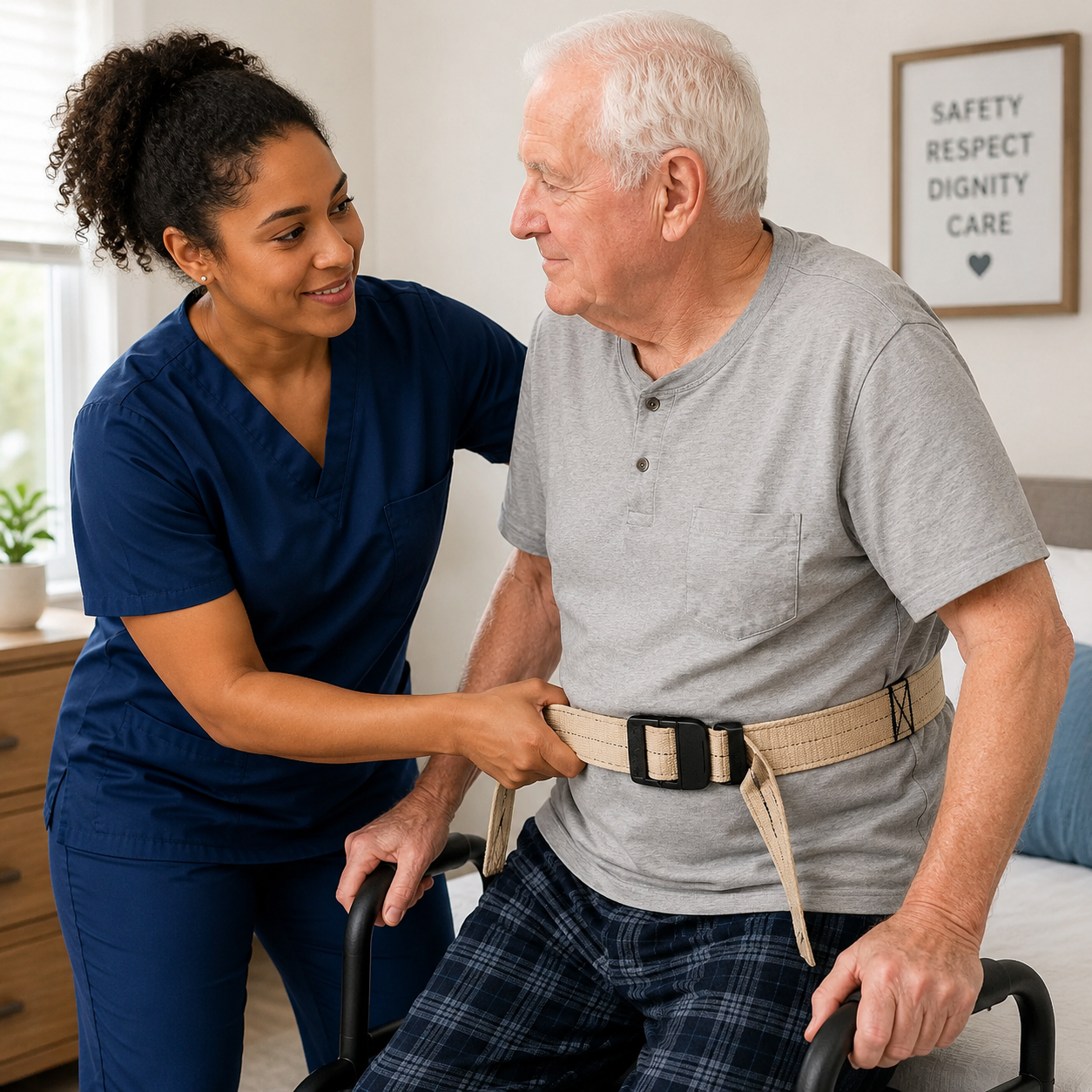
This course provides practical instruction on the safe use of gait belts during mobility assistance and transfers in home care and healthcare settings. Participants will learn proper application techniques, safety considerations, communication strategies, and common situations where gait belts may help reduce fall risks and improve caregiver support during ambulation and transfers.
Developed by: Scott Strachan RN, BSN
Target Audience
CNAs, caregivers, home health personnel, nurse registry caregivers, office staff, and healthcare professionals involved in mobility assistance and transfer support.
Teaching Method
Self-directed learning completed independently, with scenario-based reflection.
Learner Objectives
Identify the purpose and proper use of gait belts during mobility assistance and transfers.
Recognize situations where gait belt use may improve transfer safety and caregiver support.
Demonstrate understanding of communication, positioning, and environmental safety considerations during assisted ambulation.
Recognize situations where a transfer may be unsafe and when additional assistance or equipment may be appropriate.
Understand documentation and observation principles related to mobility assistance and fall prevention.
Overview
Gait belts are commonly used in healthcare and home care settings to provide additional support during mobility assistance, ambulation, repositioning, and transfers. Proper use of a gait belt may help caregivers improve stability, communication, and body mechanics while assisting individuals who require partial physical support.
This course reviews practical gait belt techniques and safety considerations commonly encountered in real-world caregiving situations. Participants will explore transfer preparation, environmental awareness, caregiver positioning, communication strategies, and common mistakes that may increase fall or injury risks.
Special attention is given to home care environments where caregivers may encounter narrow spaces, rugs, pets, uneven flooring, and limited assistance. The course emphasizes practical observation, objective documentation, and safe decision-making while maintaining professional and AHCA-defensible caregiving practices.
Disclosure
The planner(s) and author(s) of this educational activity have disclosed that there are no relevant financial relationships with any commercial interests related to the content of this course. This course is developed for educational purposes and does not receive commercial support.
Disclaimer
The information provided in this course is for educational purposes only and should not be construed as legal, financial, or professional advice. While every effort has been made to ensure accuracy, the content is not guaranteed to be free from errors or omissions. Participants are encouraged to consult with a qualified professional for specific advice related to their circumstances. The creators and presenters of this course disclaim any liability for decisions made based on the information provided.
We will send you a one-time access code.