
July 1, 2026 Has Arrived—and Alzheimer’s Training for Florida Companions Is Not Optional
Florida’s July 1, 2026 Alzheimer’s disease and related dementias training deadline has arrived.
Related: ADRD Training Requirements for Homemaker and Companion Services covers exactly what companion providers must document, and What Is ADRD Training? explains the requirement in plain English.
For thousands of Florida caregivers, companions, homemakers, independent contractors, referral sources, and home-care businesses, the transition period is over. Anyone employed, contracted, or referred to provide covered services before July 1, 2023, was required to complete the applicable ADRD training before July 1, 2026. Data being collected by C-E-U.com suggests that Florida’s companion-service industry may be dangerously unprepared.
During 2026 alone, 10,690 learners have completed C-E-U.com’s DOEA-approved two-hour ADRD training. Yet among all those learners, only one person documented that the training was being completed specifically for work as a companion.
One out of 10,690!
That is less than one-hundredth of 1 percent.
This does not prove that only one Florida companion has completed the required training. Some companions may have selected another job title, completed training through another provider, or failed to identify their precise role. But when one of Florida’s largest sources of DOEA-approved ADRD training sees almost no documented participation from the companion sector, it should be treated as an urgent warning.
Yes, Florida’s ADRD Training Law Includes Companion Services
There appears to be widespread confusion among companion-service providers and workers who believe the Alzheimer’s training requirement only applies to CNAs, home health aides, nurses, assisted living employees, or workers providing hands-on personal care.
That interpretation is incorrect.
Florida Statute 430.5025 expressly identifies a companion or homemaker service provider as a covered provider. The same statute defines “personal care” to include homemaker or companion services, along with activities of daily living, medication assistance, nursing services, and other services supporting a person’s physical, mental, or psychosocial well-being. at language is especially important because companion-service businesses generally cannot provide hands-on personal care under their AHCA registration. For purposes of the ADRD training statute, however, Florida adopted a broader definition that specifically includes providing companion or homemaker services.
In other words:
A worker does not have to bathe, dress, transfer, or provide hands-on care to fall under Florida’s ADRD training requirements.
Providing companionship to an older adult is not a loophole. It is one of the services specifically identified by the law.
The requirement also reaches contracted staff and independent contractors employed or referred by a covered provider when the worker is subject to Level 2 background screening. How Many Florida Companion Services and Workers Could Be Affected?
Florida’s companion-care sector is enormous.
AHCA’s public FloridaHealthFinder lists approximately 1,500 to 2,000 registered homemaker and companion-service providers across Florida, including roughly 190 in Miami-Dade County alone. This figure does not include the thousands of Florida home health agencies and nurse registries that may also provide or refer homemaker and companion services.
Florida does not publish a separate occupational count for workers identified specifically as companions. The closest federal category combines home health aides and personal care aides. According to the Bureau of Labor Statistics, Florida had 79,190 home health and personal care aides as of May 2023. Companions and homemakers represent only a portion of that broader category. Still, the available data strongly suggests that the number of Florida workers potentially affected by the ADRD training requirement is in the tens of thousands.
Against that backdrop, finding only one documented companion among 10,690 C-E-U.com ADRD training completions is more than a statistical anomaly. It raises an urgent question:
Do Florida’s companion-service owners and workers know that this requirement applies to them?
What Training Must Florida Companions Complete?
The requirements depend on the employee’s duties and hire date, but workers providing companion services generally fall within the following framework:
Written ADRD Information Upon Beginning Work
Covered providers must give employees basic written information about interacting with people who have Alzheimer’s disease or related dementias when employment begins.
The Required One-Hour DOEA Training
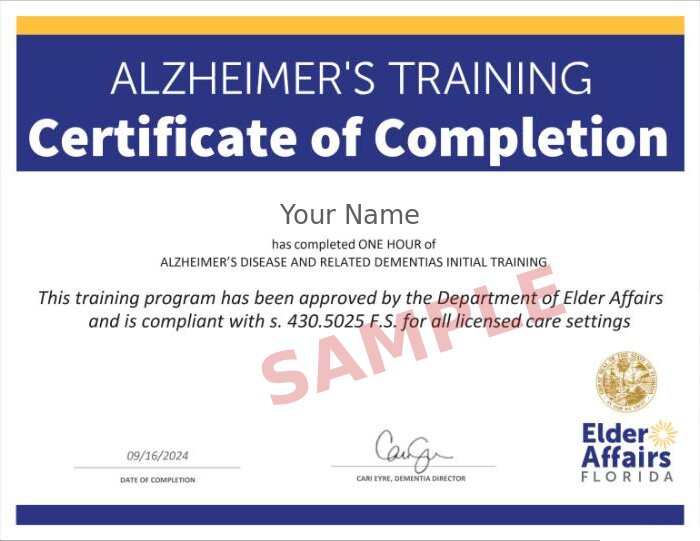
Employees who provide personal care or have regular contact with clients must complete the official one-hour Department of Elder Affairs ADRD training within 30 days after beginning employment.
This one-hour course must be completed through the Department of Elder Affairs. Another provider’s course cannot be substituted for the official DOEA one-hour program. # Two Additional Hours of ADRD Training
Within seven months after beginning work for a home health agency, nurse registry, or companion or homemaker service provider, employees providing personal care must complete two additional hours of ADRD training.
Because Florida’s ADRD statute specifically defines personal care to include homemaker or companion services, workers providing those services are included. The additional training must address areas such as behavior management, promoting independence, and working with families and caregivers. # The July 1, 2026 Legacy-Worker Deadline
People employed, contracted, or referred before July 1, 2023, were given until July 1, 2026, to complete the training required by the law. That transition period has now ended. is is not merely recommended education. It is a Florida statutory requirement.
Florida Companion-Service Owners Must Act Immediately
Every Florida homemaker and companion-service provider should immediately audit its workforce and determine:
Which workers provide companion or homemaker services.
Which workers have regular contact with clients.
Each worker’s original hire, contract, or referral date.
Whether the official one-hour DOEA certificate is in the worker’s file.
Whether the applicable additional two-hour ADRD training has been completed.
Whether the certificate was issued by an appropriately qualified provider using compliant training.
Whether all documentation is readily available for AHCA review.
Do not assume a companion is exempt because the worker does not provide hands-on care.
Do not assume that experience caring for an older adult substitutes for documented training.
Do not assume that an old dementia course automatically meets the current requirement.
Do not wait for an AHCA surveyor to explain what CZ875 or ZZ875 means.
C-E-U.com Has Already Trained More Than 10,000 Florida Caregivers in 2026
Based on known completion volume, C-E-U.com is Florida’s largest known provider of online DOEA-approved ADRD curriculum and training for the home-care workforce.
C-E-U.com’s home-health ADRD trainer approval number is HH10747.
Its two-hour online home-health ADRD curriculum is approved under curriculum number HH10743 and remains approved through April 2, 2028.
During 2026 alone, learners have completed the approved training 10,690 times.
That volume demonstrates that Florida’s nursing, home health, and caregiver communities are responding to the requirement. What is missing from the data is meaningful participation from workers identifying themselves as companions.
Florida’s companion-service industry cannot afford to continue treating Alzheimer’s and dementia training as someone else’s requirement.
The Deadline Is Here. Complete the Training Now.
Florida companions regularly spend hours alone with older adults who may have memory loss, impaired judgment, communication difficulties, wandering behaviors, agitation, or other symptoms associated with dementia.
They are often the people most likely to notice that something has changed.
Florida recognized that reality when it expressly included companion and homemaker services in its ADRD training law.
The training is required.
The July 1, 2026 deadline has arrived.
AHCA has an established deficiency tag for noncompliance.
Companion-service businesses should review every worker’s file now, complete any missing training immediately, and ensure that compliant documentation is available before the next AHCA review.
This requirement is not optional, and the absence of a certificate will not be corrected by saying that the worker was “only a companion.”
Complete Florida’s Required ADRD Training
Workers should first complete the official one-hour DOEA ADRD program when required and retain the certificate. Those who provide companion or homemaker services should also complete the applicable additional two-hour ADRD training and provide documentation to their agency, registry, or referring organization.
C-E-U.com offers convenient online access to its DOEA-approved two-hour home-health ADRD curriculum, with a completion certificate available immediately after the course requirements are successfully completed.
Do not wait for a CZ875 or ZZ875 deficiency.
Complete the required training and document compliance today.
Editorial substantiation note
“Florida’s largest known provider” is based on C-E-U.com’s internally reported 2026 completion volume. Florida does not currently publish provider-by-provider ADRD completion rankings.
The estimated statewide number of stand-alone homemaker and companion providers is derived from AHCA directory data and county-level exports. The number changes as registrations open, expire, close, or enter review. A fresh statewide AHCA export should be used when publishing a precise numeric count.